
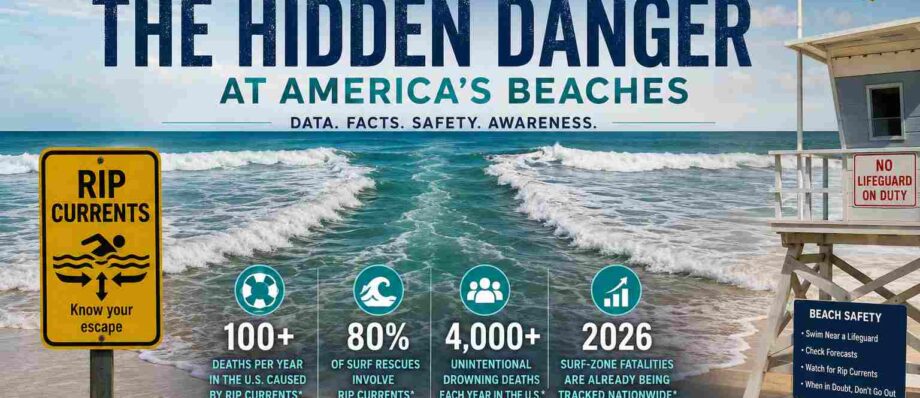
The Hidden Danger at America’s Beaches (Study)
BeachEverywhere Research
Study: The Hidden Danger at America’s Beaches
Why rip currents, drowning risk, and surf-zone conditions deserve more attention than sharks, storms, or viral beach headlines.
Key Findings
- The National Weather Service is tracking preliminary 2026 surf-zone fatalities across the United States.
- The United States Lifesaving Association reports that more than 100 deaths each year in the U.S. are attributed to rip currents.
- Published research found that rip currents were the primary cause of 81.9% of surf-beach rescues in analyzed U.S. rescue data.
- The CDC reports that more than 4,000 unintentional drowning deaths occur in the United States each year.
- Rip currents are a far more common beach danger than shark attacks.
Executive Summary
Beaches are among America’s favorite places to relax, travel, and spend time with family. But one of the most serious dangers at the beach is often difficult to see: moving water.
This BeachEverywhere study reviewed verified safety data from the National Weather Service, United States Lifesaving Association, Centers for Disease Control and Prevention, NOAA/NWS beach safety resources, and published rip-current research.
The conclusion is clear: beachgoers should take rip currents and drowning risk seriously, even when the weather looks beautiful and the ocean appears calm.
What Makes Rip Currents So Dangerous?
A rip current is a powerful, narrow channel of water moving away from shore. It does not pull swimmers underwater, but it can quickly carry them away from the beach into deeper water.
The biggest danger is exhaustion. Many people instinctively try to swim directly back to shore against the current. That can drain energy quickly and increase the risk of drowning.
Important Safety Rule
If caught in a rip current, do not fight it. Stay calm, float if needed, and swim parallel to shore until you are out of the current. Then swim back toward land at an angle.
The Data Behind the Risk
| Research Point | Verified Finding |
|---|---|
| Annual rip-current deaths | USLA reports more than 100 U.S. deaths each year are attributed to rip currents. |
| Surf rescues | A peer-reviewed study found rip currents were the primary cause of 81.9% of surf-beach rescues. |
| U.S. drowning deaths | CDC reports more than 4,000 unintentional drowning deaths occur in the U.S. each year. |
| Current-year tracking | NWS maintains preliminary surf-zone fatality data for 2026. |
Why Beachgoers Underestimate the Danger
One of the most dangerous things about rip currents is that they do not always look threatening. In some cases, the water inside a rip current may appear calmer than surrounding surf because fewer waves are breaking there.
That can create a false sense of safety. A person may enter the water where it looks easier to swim, not realizing that the water is moving away from shore.
Sharks Get Attention. Rip Currents Cause More Harm.
Shark stories often dominate beach headlines, but the data shows rip currents are a much more common safety threat for beach visitors. Historical comparisons from the Florida Museum of Natural History show far more rip-current rescues and fatalities than shark-bite fatalities in the data reviewed.
This does not mean shark safety should be ignored. It means beach safety education should focus more heavily on the hazards people are most likely to face.
How to Lower Your Risk Before Entering the Water
- Swim near a lifeguard whenever possible.
- Check the local surf-zone forecast before going into the water.
- Pay attention to beach warning flags and posted signs.
- Never swim alone.
- Keep children within arm’s reach near the water.
- Avoid alcohol before swimming.
- Stay out of the water during high-risk surf conditions.
Use BeachNearMe™ Before Your Next Beach Trip
Before visiting a beach, use BeachNearMe™ to find nearby beaches, compare locations, and plan smarter. Always check local conditions and lifeguard information before entering the water.
Find beaches near you instantly — fast, private, and app-free.
Plan Your Beach Trip
Turn your beach search into a complete trip — book stays, discover experiences, and prepare like a pro.
Plan Your Beach Trip
Turn your beach search into a complete trip — book stays, discover experiences, and prepare like a pro.
Bottom Line
The beach should be a place for memories, not tragedy. But the research shows that drowning and rip currents remain serious risks across U.S. beaches.
The most important lesson is simple: do not judge ocean safety by appearance alone. A sunny day, small waves, or calm-looking water does not always mean the beach is safe for swimming.
Better awareness, lifeguard use, and rip-current education can help prevent avoidable deaths.
Methodology
This study reviewed publicly available data and safety guidance from the National Weather Service, United States Lifesaving Association, Centers for Disease Control and Prevention, Florida Museum of Natural History, NOAA/NWS surf-zone resources, and peer-reviewed rip-current rescue research.
Sources
- National Weather Service — 2026 Surf Zone Fatalities
- United States Lifesaving Association — Rip Currents
- CDC — Drowning Data
- Natural Hazards and Earth System Sciences — Rip Current Rescues and Drowning in the United States
- Florida Museum of Natural History — Rip Currents vs. Shark Attacks
- National Weather Service — Surf Zone Forecasts
